keep dreaming

My WildFire Invention

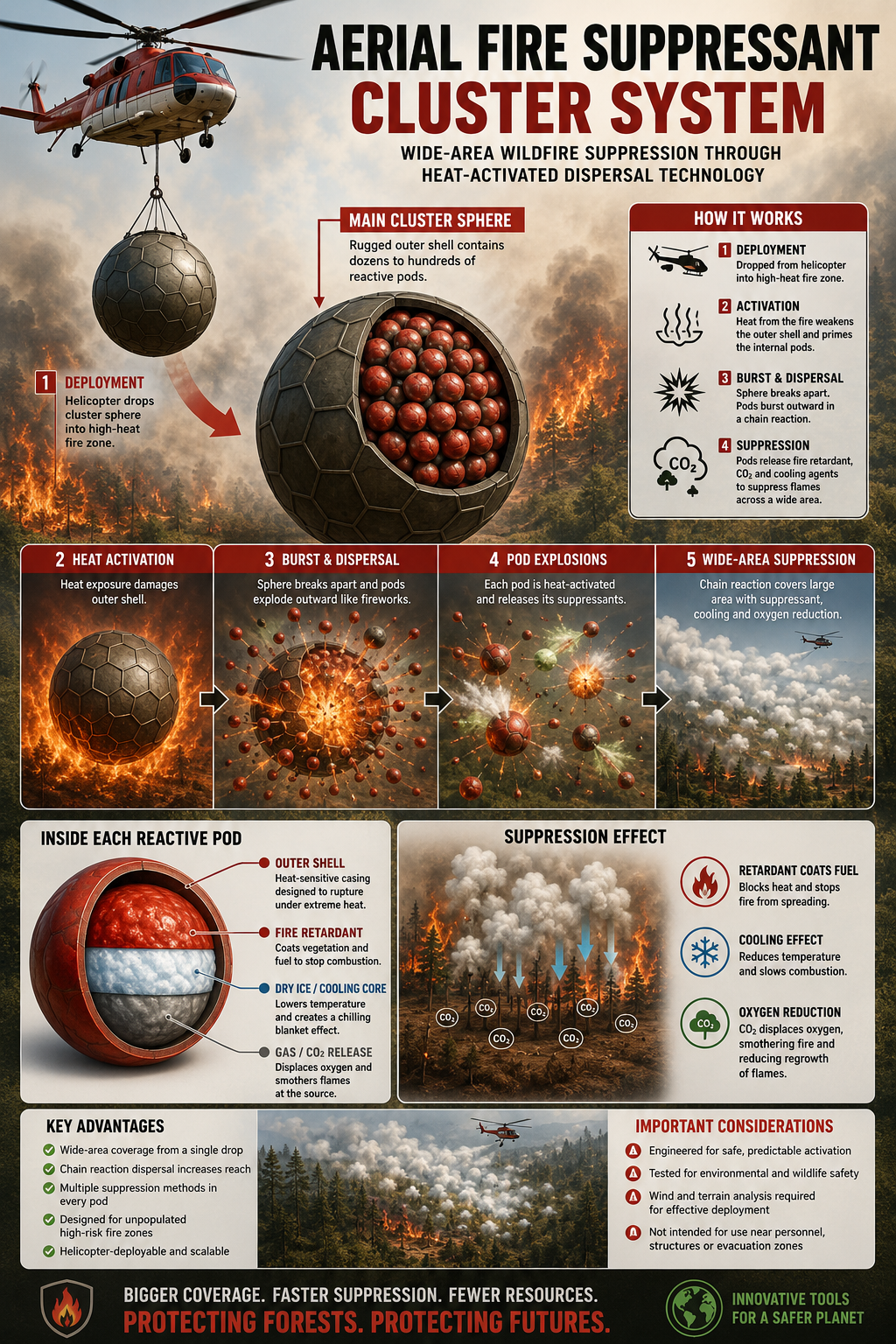
EFFECT ON FIRE: • Retardant coats vegetation • CO₂ displaces oxygen • Cooling effect lowers temperature • Chain reaction spreads suppression area
A helicopter drops a large spherical cluster device over a wildfire. This sphere contains many smaller reactive pods that: Activate when exposed to high heat Burst and scatter outward (chain reaction) Release fire retardant + cooling agents (like dry ice / CO₂) Reduce oxygen locally and suppress flames across a wide area
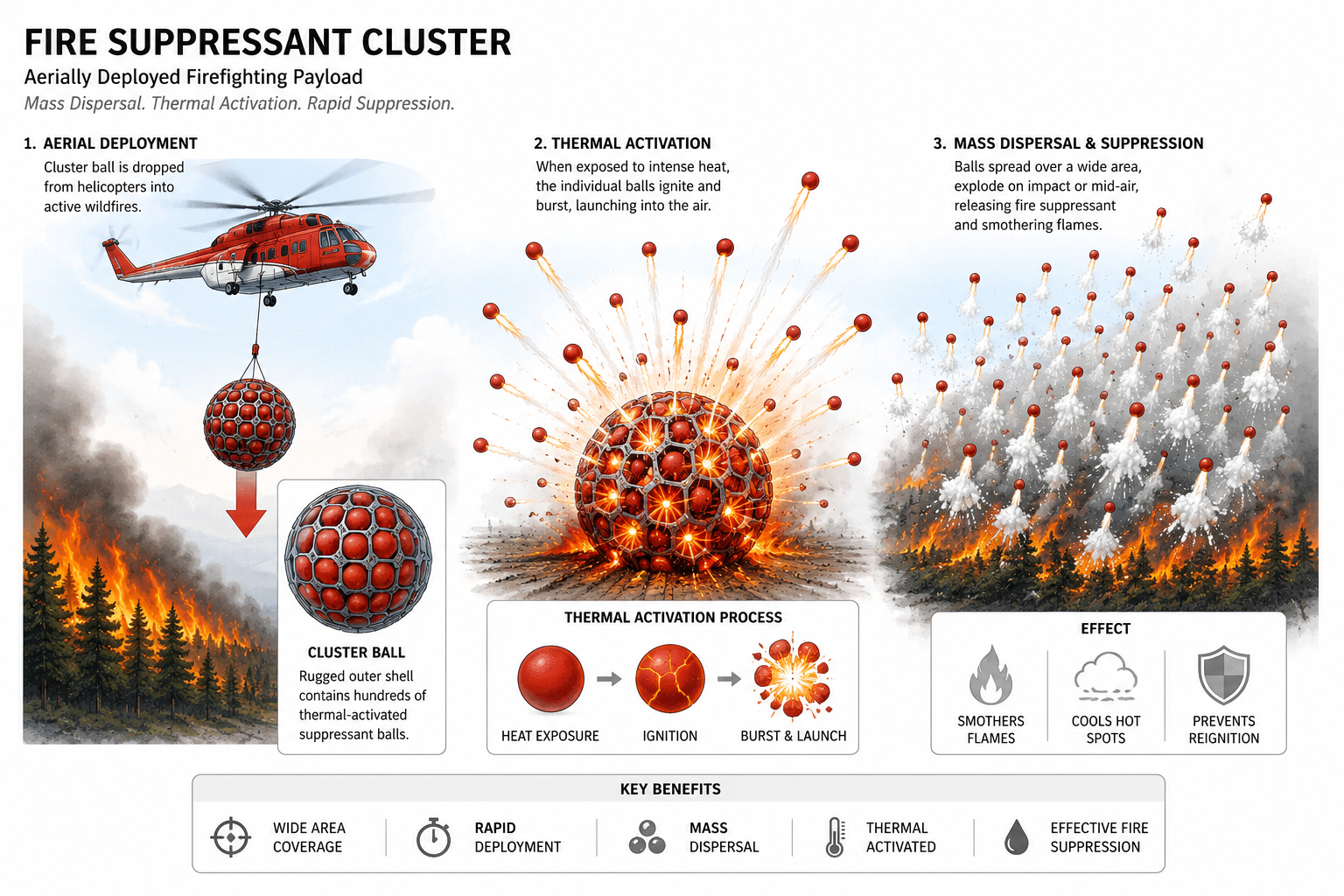
How It Works (Simplified Flow)
Deployment Dropped from helicopter into high-heat fire zone Activation Outer shell weakens under heat First Burst Main sphere breaks → releases pods Chain Reaction Pods ignite/react → scatter outward like fireworks Suppression Each pod releases:
Fire retardant (coating fuel) CO₂ / gas (reduces oxygen) Cooling material (slows combustion) 🌲 It’s A Interesting Self-spreading system → covers more area than a single drop Chain reaction dispersal → increases reach without precision targeting Multi-effect suppression:
Chemical (retardant) Physical (cooling) Atmospheric (oxygen reduction)
⚠️ Real-World Considerations (Important) To make something like this viable, engineers would need to solve:
Preventing uncontrolled explosions (safety + predictability) Avoiding harm to wildlife or firefighters Controlling spread direction (wind effects) Environmental impact of chemicals Ensuring it doesn’t unintentionally spread fire
Good morning, everyone, and thank you for giving me the opportunity to present this idea.
My name is Rossevelt Jphnson Jr, and this concept comes from something that has stayed with me from my experience as a former woodland firefighter: the danger firefighters face when battling large, fast-moving forest fires.
When we see a wildfire on television, we often see helicopters dropping water, aircraft releasing fire retardant, and firefighters working on the ground to stop the flames. But there is another side to fighting these fires that people don’t always see.
There are situations where the fire becomes so intense, the terrain becomes so dangerous, and the conditions change so quickly that firefighters can find themselves in life-threatening circumstances.
Some firefighters are even deployed into remote fire zones by parachute. These highly trained smokejumpers are sent into areas that may be difficult or impossible to reach by road. They take enormous risks to protect communities, forests, and lives.
And that raises an important question:
What if we could give firefighters another option before sending them into the most dangerous areas of a wildfire?
What if we could develop a system that delivers fire suppressant from the air, spreads it across a wider area, and helps firefighters tackle certain dangerous fire zones from a safer distance?
That question is what inspired my invention.
The Idea Behind the Invention
My concept is called the Aerial Fire Suppressant Cluster System.
The basic idea is to create a large spherical carrier containing numerous smaller suppressant pods. A helicopter would transport the carrier and deploy it over a designated wildfire zone.
Once released, the carrier would separate and distribute the smaller pods across the target area. The goal would be to deliver suppressant to multiple locations instead of relying on a single concentrated drop.
Each pod would be designed to release fire-suppressing materials over a defined area. The system would aim to combine the advantages of distributed coverage, heat-resistant delivery, and rapid deployment from the air.
The concept also explores the use of cooling materials, including dry ice or other suitable cooling agents, alongside fire retardants.
The objective is straightforward: put more suppression material where it is needed, cover more ground, and potentially reduce the need to expose firefighters to extreme danger.
Why Consider a Different Approach?
Traditional aerial firefighting is valuable, but it has limitations.
Water can cool burning materials, but it can evaporate, run off, or fail to reach every part of a fire. Wind, terrain, canopy density, and the intensity of the flames can all affect the effectiveness of an aerial drop.
Fire retardants can help slow fire spread, but they do not automatically extinguish every flame they contact.
Meanwhile, firefighters on the ground may have to work in smoke, extreme heat, steep terrain, and rapidly changing conditions.
I began thinking about whether a different type of aerial delivery system could help address some of these challenges.
Instead of delivering suppressant in one broad release, could we distribute many smaller units across a target area?
Could a single aerial deployment place suppressant in numerous locations, potentially reaching areas that a conventional drop might miss?
And could that give incident commanders another tool to consider when deciding how to protect firefighters and control a dangerous fire?
Those are the questions I want this invention to explore.
How the Cluster System Would Work
The proposed system has several stages.
First, a helicopter transports the cluster carrier to a designated area, selected by the wildfire incident commander.
Second, the carrier is released from the aircraft.
Third, the carrier separates into multiple smaller suppressant pods, distributing them across the target zone.
Fourth, the pods release their suppressant materials using a controlled, engineered mechanism.
Finally, the intended result is a broader pattern of fire suppression that could help cool affected areas, protect selected vegetation, and slow the spread of flames.
The original concept also explores heat-triggered activation. However, this would need extensive engineering and testing to ensure the pods activate predictably, disperse safely, and never create additional hazards.
I want to emphasize that these are proposed functions, not proven performance claims. The design would need to demonstrate that it can work safely and effectively under real wildfire conditions.
An Important Point About Oxygen and Cooling
Part of my original thinking involved releasing dry ice, which produces carbon dioxide, to help reduce the conditions that allow a fire to burn.
That idea would need careful scientific evaluation.
Carbon dioxide can suppress certain fires in confined environments, but an open forest is very different. Wind and atmospheric mixing can rapidly disperse gases, and creating dangerous oxygen-deficient conditions could threaten firefighters, wildlife, and nearby communities.
For that reason, the invention should prioritize proven fire-retardant materials and validated cooling methods. Any use of dry ice or gas-release technology would need to be justified through independent safety and environmental testing.
The objective is not to create another danger. It is to develop a tool that reduces danger.
Protecting the People Who Fight These Fires
For me, this is about more than equipment.
It is about the people who enter the forest when everyone else is trying to get out.
It is about firefighters who face unpredictable conditions to protect lives and property. It is about smokejumpers who parachute into remote terrain because the fire cannot wait. And it is about the families who hope their loved ones return home safely.
I am not suggesting that this invention could replace firefighters, smokejumpers, helicopters, or existing firefighting aircraft.
Those professionals will remain essential.
Instead, I want to explore whether an additional aerial suppression tool could help them manage certain high-risk situations, support their operations, or reduce the need for dangerous ground deployments in some circumstances.
The goal would be to make the most dangerous assignments a genuine last resort whenever circumstances allow.
What Needs to Happen Next?
This invention is currently a concept that needs further development.
The next steps would involve working with wildfire specialists, fire-protection engineers, chemical and materials scientists, aviation professionals, and environmental experts.
They would need to evaluate the suppressant materials, the delivery mechanism, the coverage area, the effects of wind, the risks of uncontrolled dispersal, and the possibility of accidental ignition or injury.
The system would also need to be compared against existing aerial firefighting methods to establish whether it provides a meaningful advantage.
Any prototype testing should begin in controlled, non-wildfire conditions, followed by appropriately authorized testing under expert supervision.
Only after demonstrating safety and effectiveness could anyone responsibly determine whether this approach belongs in operational wildfire response.
Closing Statement
I developed this idea because I have seen the challenges of woodland firefighting, and I believe we should continue looking for better ways to protect the people who do this dangerous work.
Sometimes, progress begins with a simple question: Is there another way?
My question is whether a cluster-based aerial suppressant system could give firefighters another option when conventional methods face limitations and conditions become extremely dangerous.
I am bringing this concept forward not as a finished solution, but as an idea worth examining, testing, and improving with the help of people who understand the science and realities of wildfire suppression.
If further research shows that it can work safely, it could become another tool in the effort to protect forests, communities, and the lives of firefighters.
Because the ultimate purpose of any firefighting invention should be simple: to control the fire while bringing as many people home safely as possible.
Thank you.